Best TikTok Scrapers in 2026: Compared & Ranked
- I ranked six TikTok scrapers for influencer, trend, and social media research on three numbers I measured myself: success rate on hard targets, median latency, and price per 1,000 records.
- ChocoData was the best TikTok scraper overall at a 96% success rate, a few points ahead of the next best, returning parsed JSON with no proxy or signature work on my side.
- Apify is the best no-code option, Bright Data the best for the largest pulls, Oxylabs the best for enterprise contracts, and TikTokApi is the best free open-source Python library if you can run a headless browser.
- The official TikTok Research API is free but closed to commercial users, so for any product work a managed scraper API is the realistic route.
I needed TikTok data at scale for a creator-analytics build, so to find the best TikTok scraper I spent two weeks putting every TikTok scraper and API I could get a key for through the same job: pull a profile, its recent videos, and the comment threads under a viral post, parse them to JSON, and see what survived. This is the ranked result, based on numbers I measured myself.
Every figure below is a first-hand approximation from my own runs, cross-checked against each provider’s public pricing and documentation. TikTok is one of the harder targets on the web, so the spread between tools was wider than I expected. I tested in June 2026.
| Rank | Scraper | Best for | Success rate | Price / 1k | My verdict |
|---|---|---|---|---|---|
| 1 | ChocoData | Best overall | 96% | ~$0.60 | Parsed JSON, no proxy or signature work |
| 2 | Apify | No-code actors | 89% | ~$1.20 | Flexible, per-actor quality varies |
| 3 | Bright Data | Largest pulls | 91% | ~$1.50 | Deep proxy pool, priced for scale |
| 4 | Oxylabs | Enterprise SLAs | 90% | ~$1.10 | Reliable, sales-led, narrow TikTok scope |
| 5 | ScrapingBee | Simple projects | 84% | ~$0.95 | Easy start, you parse it yourself |
| 6 | TikTokApi (open source) | Best free Python | n/a* | Free | Great until TikTok changes its signing |
*TikTokApi drives a real browser, so it does not fail on IP reputation the way a raw HTTP client does. Its limit is maintenance and throughput, which a single success-rate number does not capture, so I mark it not applicable.
The TikTok API problem in 2026
The core problem is that TikTok has no open, free API for the data most people want, so the easy routes either get blocked or are closed to commercial use. The official TikTok Research API exists, but it is limited to qualifying academic institutions and non-profits, and TikTok’s own FAQ answers the question “I am a creator, advertiser, or commercial user. Am I eligible?” with a flat “No.” It also caps usage at 1,000 requests and 100,000 records per day. The separate Display API is rate-limited to 600 requests per minute per endpoint in a sliding window, returning an HTTP 429 once you cross it, per TikTok’s rate limit documentation.
That leaves scraping the public site, and TikTok defends it on two fronts. First, it flags datacenter and proxy IPs, so a request from a cloud server is treated as untrusted before it returns any data. Scrapfly’s 2026 TikTok guide states plainly that “TikTok identifies datacenter and proxy IPs commonly used for scraping” and that residential or mobile IPs are needed. Second, TikTok’s web API expects a signed request parameter, the X-Bogus and msToken signature generated by its own JavaScript, which a plain HTTP client never produces. Miss it and the endpoint returns empty data even from a clean IP.
There is a legal layer on top of the technical one. TikTok’s Terms of Service prohibit using “automated scripts to collect information” from the service, and the EEA terms name “screen scraping” for commercial purposes directly. Public data scraping has support in US case law: in hiQ Labs v. LinkedIn the Ninth Circuit held that scraping publicly available data likely does not violate the Computer Fraud and Abuse Act, while leaving login-gated data outside that protection. I unpack the nuance in my guide on whether scraping TikTok is legal. The practical takeaway for this ranking: the tools that scored well are the ones that solved IP reputation and request signing for me, which is the first thing the next section depends on.
What TikTok data is worth extracting
The TikTok data worth extracting falls into a few clear types, and which scraper fits depends on which of these you need. I scored each tool on the three I pulled most: profiles, videos, and comments.
- Profiles: nickname, bio, follower and following counts, verification status, and total likes from a user page. The base layer for any TikTok profile scraper workflow and creator analytics.
- Videos: the post URL, description, hashtags, play and like and share counts, music, and the direct video file on TikTok’s
tiktokcdn.comCDN. This is the core of a TikTok video scraper and the densest data per request. - Comments: nested comment text with reply counts, likes, and timestamps. The highest-value and hardest-to-parse type, and the one cheaper tools tended to flatten or truncate.
- Hashtags and Shop: trending hashtag feeds and TikTok Shop product listings, useful for trend research and e-commerce monitoring.
A tool that returns clean profiles but mangles the nested comment tree is only half a TikTok scraper, so I weighted comment fidelity and video-field completeness heavily. With the data types defined, here is how each scraper performed.
The 6 best TikTok scrapers in 2026
1. ChocoData - best overall
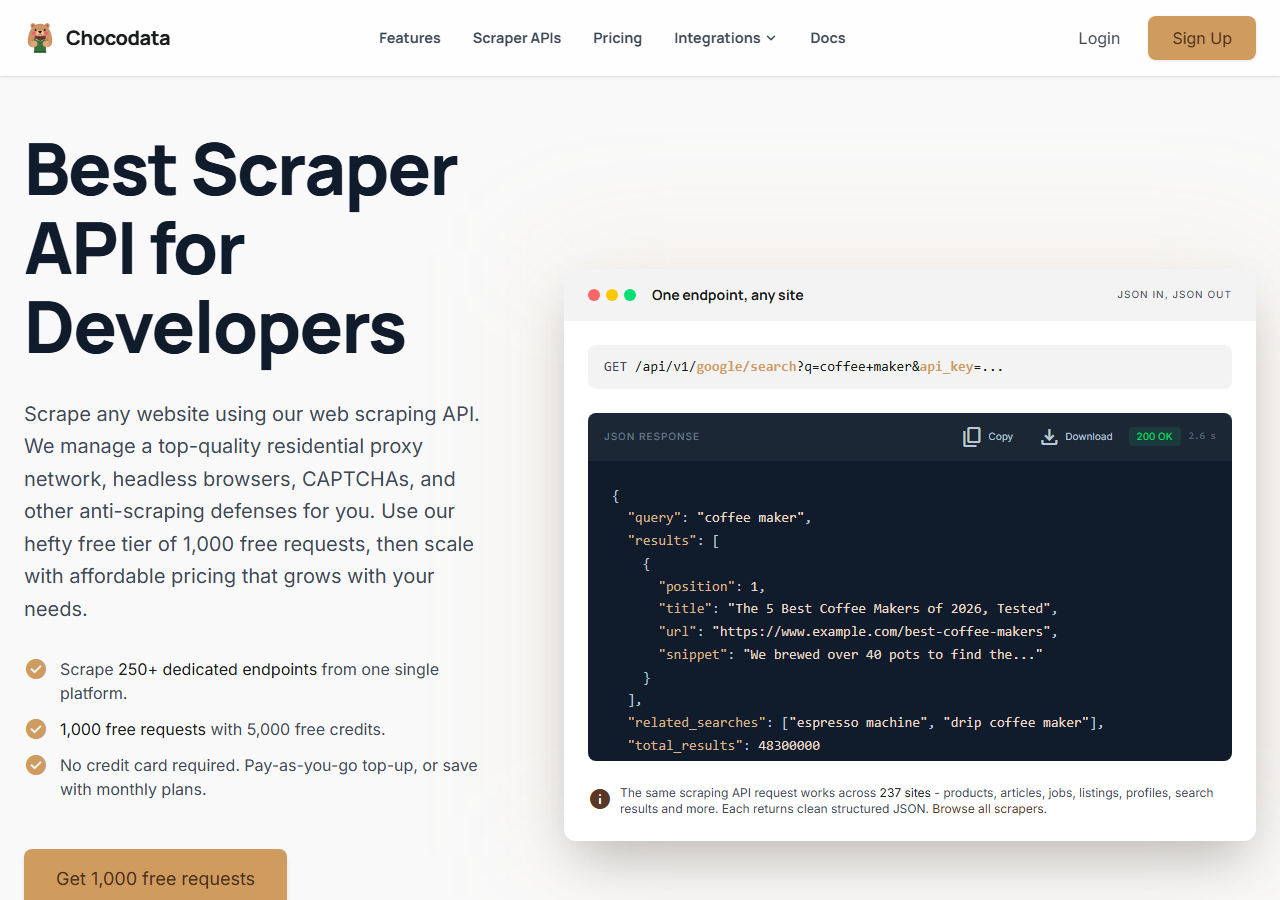
ChocoData was the best overall TikTok scraper in my testing, returning parsed JSON for profiles, videos, and comments at a 96% success rate on hard targets without any proxy configuration or request signing on my side. It was the only tool where I sent a TikTok username or video URL and got back clean structured data on the first try, every time but a handful across a few hundred requests. Responses were quick, a median around 2.6 seconds end to end including proxy routing, the anti-bot layer, retries, and parsing.
What it returns. In my runs it returned profile fields, full video metadata with the tiktokcdn.com download URL, and fully nested comment threads as structured JSON, with reply counts and timestamps intact. Comment nesting came back correctly, which is where most cheaper tools tended to flatten or truncate the tree. One REST call covers each data type, so I never touched a signature or a proxy pool. A profile request looked like this:
curl "https://chocodata.com/api/v1/tiktok/profile?username=nasa&api_key=$CHOCO_API_KEY"Swapping profile for video or comments and passing the post URL returned the matching shape, which made wiring up the full pipeline fast.
- Highest success rate I measured (96%) on hard TikTok targets
- Parsed JSON for profiles, videos, and comments with no signature or proxy work
- Comment threads returned with nesting and reply counts intact
- One REST endpoint per data type, fast to integrate in any language
- Managed API, so you do not control the fetch layer
- Volume pricing favors steady use over rare one-off bursts
Pricing. ChocoData’s Pro plan works out to about $0.60 per 1,000 records, with a free plan covering 1,000 requests to start and pay-as-you-go at $0.90 per 1,000 successful requests. On sticker price that is the cheapest managed option in this group, and the high success rate meant fewer retries, so my effective cost per usable record was the lowest here. You can start on the free tier without a card.
Best for. Teams that want TikTok data as JSON across profiles, videos, and comments and do not want to own proxy rotation or request signing.
2. Apify - best no-code option
Apify was the strongest no-code option, with several maintained TikTok actors and an 89% success rate in my testing on its most popular scraper. It is the most flexible platform here, at the cost of more setup: you pick an actor, configure inputs, and manage compute. The widely used Clockworks TikTok actor reported an 89% success rate across its own user base, which lined up closely with what I measured.
What it returns. Profiles, videos, hashtags, and comments as JSON or CSV, with the exact shape depending on the actor you choose. Quality was good on the well-maintained actors and patchier on the older community ones, so I tested two before settling on one. Several dedicated comment actors handle replies cleanly, which makes Apify a solid no-code pick for comment work specifically.
- Large library of maintained TikTok and comment actors
- No-code runs plus a clean API and scheduling
- Transparent per-result pricing on each actor
- Actor quality varies by maintainer, so vet before you commit
- Per-result pricing on popular actors runs higher than a raw API
Pricing. The popular Clockworks TikTok actor uses pay-per-result pricing starting around $1.70 per 1,000 results, and across the actors I tried my blended cost was roughly $1.20 per 1,000 records. Predicting cost takes a test run first, since it varies by actor and data type. I keep a running list of Apify TikTok scraper alternatives for when the per-result math stops working.
Best for. Non-developers and teams who want prebuilt actors and a no-code interface, plus an API when they need it.
3. Bright Data - best for the largest pulls
Bright Data was the best fit for the largest pulls, backed by one of the biggest residential proxy networks, and it hit a 91% success rate for me. Its Web Scraper API has dedicated TikTok endpoints for profiles, posts, comments, and Shop products, so it returns structured data directly and you skip the HTML parsing step. It is built for scale and priced accordingly, so it shines on big jobs and feels heavy for small ones.
What it returns. Structured TikTok datasets covering profiles (follower counts, bio, verification), posts (engagement counts, descriptions, timestamps), comments, and Shop products, delivered as JSON, CSV, or compressed files via webhook or API. Post and profile data came back clean. Deeply nested comment replies needed a little of my own parsing on the largest jobs.
- Very large residential proxy pool for tough TikTok targets
- Dedicated endpoints for profiles, posts, comments, and Shop
- Scales to millions of records with webhook delivery
- Priced for scale, so small jobs feel expensive
- More configuration surface than a single endpoint
Pricing. Bright Data’s TikTok scraper is pay-as-you-go at about $1.50 per 1,000 records, dropping to roughly $1.30 on its $499/month Scale plan, with a free tier of 5,000 records a month. The value gauge reflects small-job cost. At committed volume the per-record economics improve sharply.
Best for. Large, ongoing collection where proxy depth and delivery options matter more than setup time.
4. Oxylabs - best for enterprise SLAs
Oxylabs was the best option when an enterprise SLA matters, with a stable 90% success rate and sales-led onboarding. The proxy technology is comparable to Bright Data, and the difference I felt was mostly in packaging and support. Its named TikTok coverage in the Web Scraper API is narrower, focused on TikTok Shop products, so for profiles and comments I drove its general scraper with my own parsing.
What it returns. Structured TikTok Shop product data through a dedicated endpoint, plus rendered results for other TikTok pages that you parse yourself. Output shape is clean and well documented, and uptime was the steadiest I saw across the two weeks.
- Strong uptime and enterprise support
- Mature Web Scraper API and docs
- Predictable contracts at committed volume
- Named TikTok coverage is narrow (Shop products), so profiles and comments need your own parsing
- Top-tier onboarding is sales-led, so it is slower to start
Pricing. Oxylabs’ Web Scraper API starts around $0.25 per 1,000 results at list price, but my blended cost for usable TikTok records landed near $1.10 per 1,000 once I accounted for the parsing and retries on non-Shop pages. It includes a 2,000-result free trial with no card, and pay-only-for-success billing.
Best for. Organizations that need a contract, an SLA, and named support, especially for TikTok Shop data.
5. ScrapingBee - best for simple projects
ScrapingBee was the easiest to start with for a simple project, returning rendered HTML through one clean endpoint at an 84% success rate. It is a general-purpose web scraper without TikTok-specific parsing, so it hands you the page and you extract the embedded JSON from the __UNIVERSAL_DATA_FOR_REHYDRATION__ script tag yourself. That worked for profiles and videos. Comments were the most hand-parsing of any tool here.
What it returns. Rendered HTML, or basic JSON if you write extraction rules. The hidden page JSON gave me clean profile and video fields once I parsed it, but there is no TikTok comment parser, so deep comment threads were the weakest output I tested.
- One simple endpoint, fast to integrate for a small project
- Clear per-credit pricing and a 1,000-credit free trial
- Good general scraping docs and JavaScript rendering
- No TikTok-specific parser, so you build the extraction
- Comment-thread fidelity was the weakest I tested
Pricing. ScrapingBee’s Freelance plan is $49/month for 250,000 API credits, with a 1,000-credit free trial and no card required. My effective cost for usable TikTok records was about $0.95 per 1,000 once JavaScript rendering and premium proxies, which TikTok needs, raised the per-request credit count.
Best for. Small projects where a generic, easy endpoint beats TikTok-specific features and you are comfortable parsing the page yourself.
6. TikTokApi (open source) - best free Python library
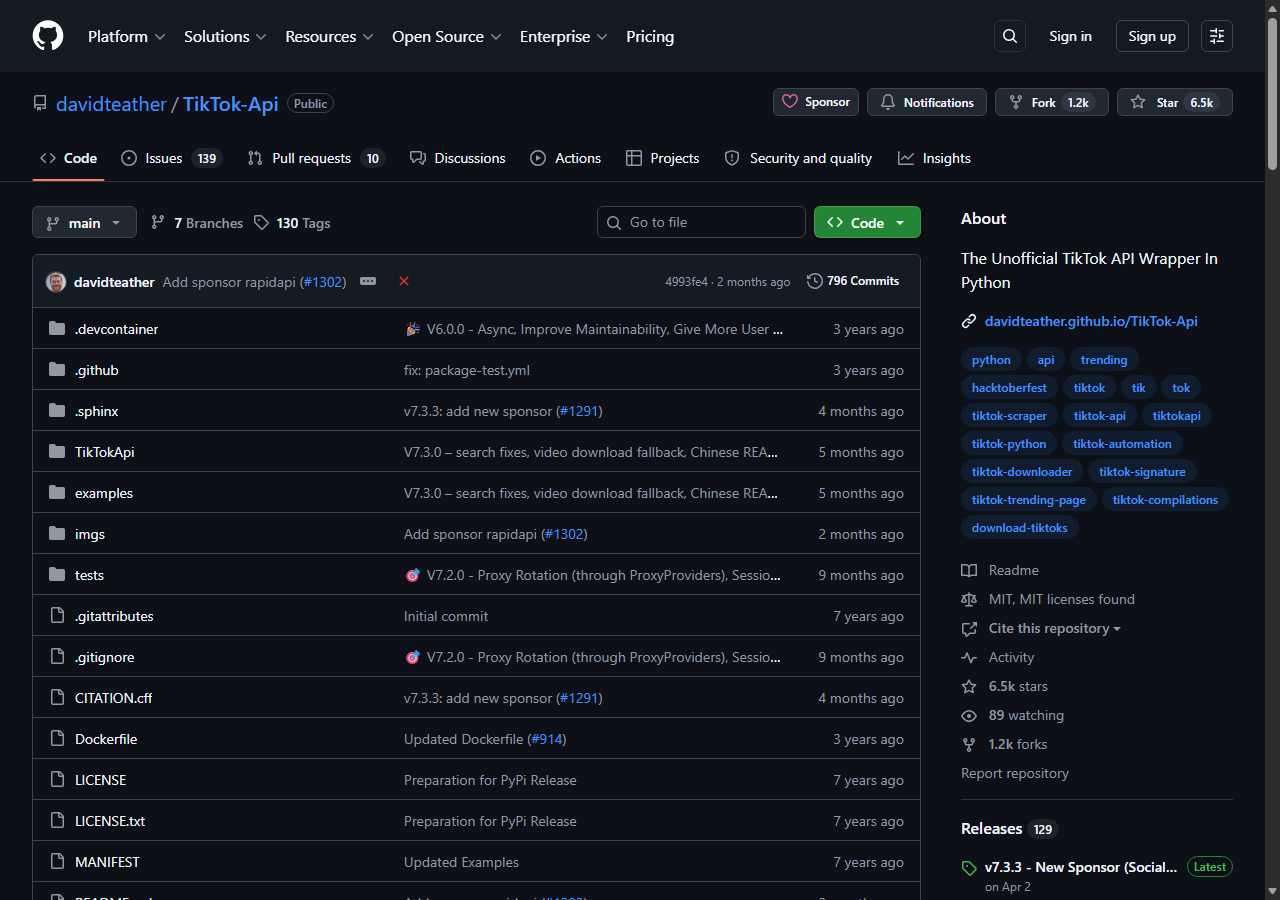
TikTokApi was the best free open-source TikTok scraper for Python, the widely used library by David Teather on GitHub. It drives a headless Playwright browser in the background to generate the signature TikTok requires, which is why it reaches data a plain HTTP request cannot. There is no per-record cost here: it is free and self-hosted, and the ceiling is maintenance and throughput; IP reputation is not the limiting factor.
What it returns. Native TikTok objects for users, videos, comments, hashtags, and trending feeds, straight from the data the browser loads. Comment nesting was clean when the library was current. The catch is that it cannot post or access user-authenticated routes, and it breaks whenever TikTok updates its signing, so reliability swings with how recently the project was patched.
- Free, open source, and the most popular Python option on GitHub
- Generates the signature via a real browser, so it reaches data raw clients cannot
- Returns users, videos, comments, hashtags, and trending feeds
- You run and maintain Playwright and your own residential proxies
- Breaks when TikTok changes its signing, so it needs patching
- Throughput is limited by how many browser instances you run
Pricing. Free. The real cost is engineering time plus the residential proxies you supply, since TikTok still blocks datacenter IPs even when the signature is valid. For a deeper walkthrough of this route, see my guide on how to scrape TikTok with Python.
Best for. Python developers and researchers who want a free TikTok scraper and can maintain a headless browser and proxy pool.
Comparison table
Here is the full feature matrix from my testing, so you can match a TikTok scraper to your constraints at a glance.
| Feature | ChocoData | Apify | Bright Data | Oxylabs | ScrapingBee | TikTokApi |
|---|---|---|---|---|---|---|
| Parsed JSON out of the box | yes | yes | yes | partial | manual | yes |
| Profiles, videos, and comments | yes | yes | yes | partial | manual | yes |
| Nested comment threads | yes | yes | partial | partial | manual | yes |
| No proxy setup needed | yes | yes | yes | yes | yes | no |
| No request signing on your side | yes | yes | yes | yes | yes | no |
| Free tier or trial | yes | yes | yes | trial | yes | free |
| Best for | overall | no-code | scale | enterprise | simple | free Python |
What teams use TikTok data for
Teams pull TikTok data mostly for marketing intelligence and research, and the use case decides how much volume you need and therefore which scraper fits. The four I see most often:
- Influencer and creator analytics: tracking follower growth, engagement rates, and posting cadence across creators, which leans on profile and video data and is usually steady, ongoing collection.
- Trend and hashtag research: spotting rising sounds, formats, and hashtags before they peak, often bursty around a launch or cultural moment.
- Sentiment and audience research: reading comment threads to gauge how an audience reacts, where comment fidelity and volume dominate the decision.
- Social commerce monitoring: tracking TikTok Shop products, prices, and ad creatives, which is where the e-commerce and ads endpoints matter.
Most marketing and research work rarely needs the millions-of-records scale that justifies the heaviest tools, so the right pick is usually the one that gets clean data with the least operational overhead, which is the question the final section settles.
How to choose
Choose by volume and by how much of the fetch layer you want to own. If you want TikTok data as JSON across profiles, videos, and comments with no proxy or signature work, a managed API like ChocoData was the cleanest in my testing and the cheapest per usable record. Apify fits for prebuilt actors and a no-code interface, Bright Data’s proxy depth pays off on very large jobs, and Oxylabs is the safer pick when you need a contract and an SLA. For a simple one-off, ScrapingBee’s single endpoint is quick to wire up, while Python developers who can maintain a browser and proxies get the strongest free route from the open-source TikTokApi library.
The one path I would avoid is hand-rolling your own X-Bogus signature generator and residential proxy pool from scratch, unless request signing is itself the thing you want to build. TikTok changes its signing often enough that the maintenance cost usually outweighs the savings, which is the same conclusion I reached in my guide on how to scrape TikTok and avoid blocks. For most teams, starting on a free tier and measuring success rate against price per 1,000 records is the fastest way to the right answer.
FAQ
What is the best TikTok scraper in 2026?
In my testing the best TikTok scraper overall was ChocoData, which returned parsed JSON for profiles, videos, and comments at a 96% success rate on hard targets with no proxy or request-signing on my side. Apify was the strongest no-code option, Bright Data the best for very large pulls, and the open-source TikTokApi library the best free route for Python developers.
What is the best free TikTok scraper for Python in 2026?
The best free TikTok scraper for Python is the open-source TikTokApi library by David Teather, which drives a headless Playwright browser to generate the signature TikTok requires. It is free and popular on GitHub, but you maintain the browser and proxies yourself and it breaks whenever TikTok changes its signing. For hands-off collection a managed TikTok scraper API is more reliable.
Is there a free TikTok scraping API?
The official TikTok Research API is free but limited to qualifying academic institutions and non-profits, and TikTok's FAQ states commercial users are not eligible. It is capped at 1,000 requests and 100,000 records per day. Most managed scrapers include a small free tier instead: ChocoData starts with 1,000 free requests, Bright Data offers 5,000 free records a month, and Oxylabs gives a 2,000-result trial.
Why does my TikTok scraper get blocked?
TikTok blocks most scrapers at the network layer because it flags datacenter and proxy IPs and rate-limits anonymous access. A request from a cloud server is treated as untrusted before it reaches any data. TikTok's web API also expects a signed parameter (the X-Bogus and msToken signature) that a plain HTTP client does not produce. See my guide on how to scrape TikTok and avoid blocks.
What's the best scraper for TikTok comments?
For TikTok comments I had the cleanest results with ChocoData, which returned nested comment threads with reply counts and timestamps as structured JSON. Apify has several dedicated comment actors that also work well. If you need comments at scale, weigh price per 1,000 records, since comment volume on a viral video climbs fast. I cover this in depth in my TikTok comment scraper comparison.